
Don’t Overlook the Income Side of Fixed Income
Amid bond market tumult, elevated yields are contributing to returns and offering investors a nice income stream.


You’d think the performance numbers for Morningstar’s fixed-income indexes would be worse. Bond market turmoil has captured headlines in 2026. Inflation, interest rate hikes, and debt fears have pushed US Treasury yields to levels not seen since the early 2000s. Artificial intelligence-related borrowing is a growing concern.
Yet the Morningstar US Core Bond Index is down less than 3% for the first three quarters of the year, and losses across fixed-income asset classes aren’t exactly devastating. October has even seen a performance uptick.
Morningstar US Fixed-Income Index Returns
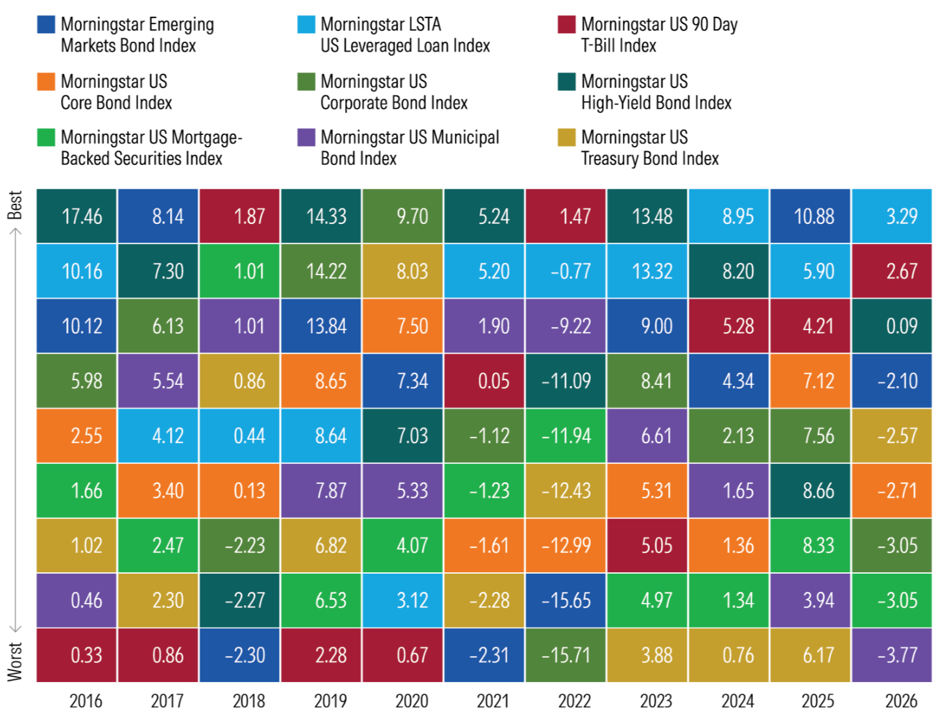
Fixed-income returns in 2026 are a far cry from 2022, dubbed the “worst bond market ever.” The stock market also declined by double digits that year, making things a lot worse. Inflation was running hotter then, too, and interest rate hikes were far more severe.
Income is another key difference between 2026 and 2022. Bond yields at the start of 2022 were barely above 2%. Going into this year, the Morningstar US Core Bond Index yielded north of 4%. That income return has helped offset bonds’ price declines.
Undoubtedly, this has been a troublesome year for fixed income. Risks remain. But on the bright side, income investors can access attractive yield streams.
Income’s Contribution to Total Return
The Morningstar US Core Bond Index’s yield history is instructive. In the graph below, you can see how yields have shot up in 2026. While current yields might be high relative to the years running from the 2008 global financial crisis through the pandemic, they did reach these levels in late 2023. And they look normal in the context of the early 2000s.
Bond Yields Are High Compared With Post-Financial Crisis Era Levels but Not Early-2000s Levels
The graph also shows that yields had nowhere to go but up in the early coronavirus era. In 2022, the US inflation rate hit 9%, thanks to a confluence of pandemic stimulus, supply chain bottlenecks, and soaring oil prices following Russia’s invasion of Ukraine. The Federal Reserve responded by hiking rates seven times by a total of 4.25 percentage points. By the third quarter of 2023, the Morningstar US Core Bond Index yielded 5.6%.
Yields fell in 2024 and 2025, years in which the Federal Reserve cut interest rates. But the Morningstar US Core Bond Index’s 4.3% yield at the start of 2026 put it in a much better position to withstand bond price declines caused by rising yields.
To put some numbers on it, from the start of 2026 through the third quarter, the Morningstar US Core Bond Index declined by 2.71%. Price return alone for the index was negative 5.67%. But income return contributed 2.84%.
Bond Market Pain Isn’t Being Felt Equally
Income also helps explain relative returns for indexes in 2026. It’s no coincidence that the high-yielding Morningstar LSTA US Leveraged Loan Index is the year’s top performer. Yes, syndicated bank loans were hit early this year by a selloff in software. But having started the year with an 8% yield gave the index plenty of cushion. It also helps that loans have relatively short durations, as well as floating-rate coupons that rise along with interest rates.
The same cannot be said of high-yield bonds and emerging-market debt, two other asset classes that carry significant credit risk. Both have lost less than the core bond index so far in 2026 thanks to income return. The Morningstar US High-Yield Bond Index is even in positive territory.
Bringing up the rear for the first three quarters of 2026 is the Morningstar US Municipal Bond Index. “After a strong first half, a mix of rising interest rates and too much supply led municipal bonds to sell off more sharply than every major fixed-income sector except long-term Treasuries,” wrote Morningstar manager research analyst Ken Noguchi after the third quarter.
Putting the Income in Fixed Income
The good news now is that yields on fixed income comfortably exceed the inflation rate, not to mention the US stock market’s paltry dividend yield. Most impressive is the Morningstar LSTA US Leveraged Loan Index’s yield of 9.05%. But the Morningstar US Core Bond Index’s 5.5% yield is not too shabby and comes with less credit risk and more diversification benefits relative to stocks.
Income Levels Look Strong Across Fixed-Income Asset Classes
Some investors might question the merit of bonds, preferring to sit in high-yielding cash instruments. “Not only are the yields on various types of cash products compelling today, but cash also offers safety and liquidity,” wrote Morningstar’s Christine Benz recently. “If you’re a cash investor, you do not have the potential for principal volatility,” she continued.
On the other hand, cash doesn’t have the same capital appreciation potential as bonds. Yields can be fleeting. And cash yields don’t always beat inflation.
Where Rates Will Go, Nobody Knows
Bond investors may be wondering whether rates could continue to rise. They certainly could. As of late October, the bond market is pricing in a higher short-term federal-funds rate. Inflation, the national debt, and AI spending pressures are all exerting upward pressure on yields. For what it’s worth, Morningstar economist Preston Caldwell expects the Fed to return to rate cuts in 2027 and 2028.
Interest rate forecasts are difficult, and even professional investors frequently get them wrong. Recall that going into 2024, the market was expecting six or seven interest rate cuts. It got three.
Rather than basing allocation decisions on rate expectations, it’s best to take a long-term strategic approach. As 2026 shows, bonds can lose money. But they also stabilize portfolios, diversify equity market risk, and have more capital appreciation potential than cash. Today’s yields are a decent starting place for both income and total return oriented investors.
The author or authors do not own shares in any securities mentioned in this article. Find out about Morningstar’s editorial policies.
Morningstar, Inc., licenses indexes to financial institutions as the tracking indexes for investable products, such as exchange-traded funds, sponsored by the financial institution. The license fee for such use is paid by the sponsoring financial institution based mainly on the total assets of the investable product. A list of ETFs that track a Morningstar index is available via the Capabilities section at indexes.morningstar.com. A list of other investable products linked to a Morningstar index is available upon request. Morningstar, Inc., does not market, sell, or make any representations regarding the advisability of investing in any investable product that tracks a Morningstar index.

 United States